Healing Complex Trauma Through Kintsugi: The Beauty of Integration
READING TIME: 11 MIN | PSYCHOEDUCATION | INSPIRATION
Do you sometimes feel as though you are not good enough?
As though you are functioning on the outside while something entirely different is happening within you?
Perhaps you worry that others might see your anger, shame, or insecurity - or realise how much effort it takes to maintain the facade that has protected you for so long.
Thoughts such as “I am too much,” “I am unlovable,” or “There is something wrong with me” can feel like facts. Yet they are often conclusions shaped by earlier experiences, particularly at times when essential needs for safety, protection, care, or belonging were not adequately met.
Such beliefs can be connected to the effects of complex trauma. Healing does not mean undoing the past, nor does it require you to find something positive in every painful experience. It means beginning to understand your reactions, recognising the ways they once protected you, and developing a more compassionate relationship with yourself.
Metaphors help me make psychological processes not only understandable, but also visible and emotionally tangible. I often use them in my therapeutic work.
For me, the Japanese art of Kintsugi offers a particularly meaningful image of what can unfold in trauma therapy, and within the therapeutic relationship between you and me.
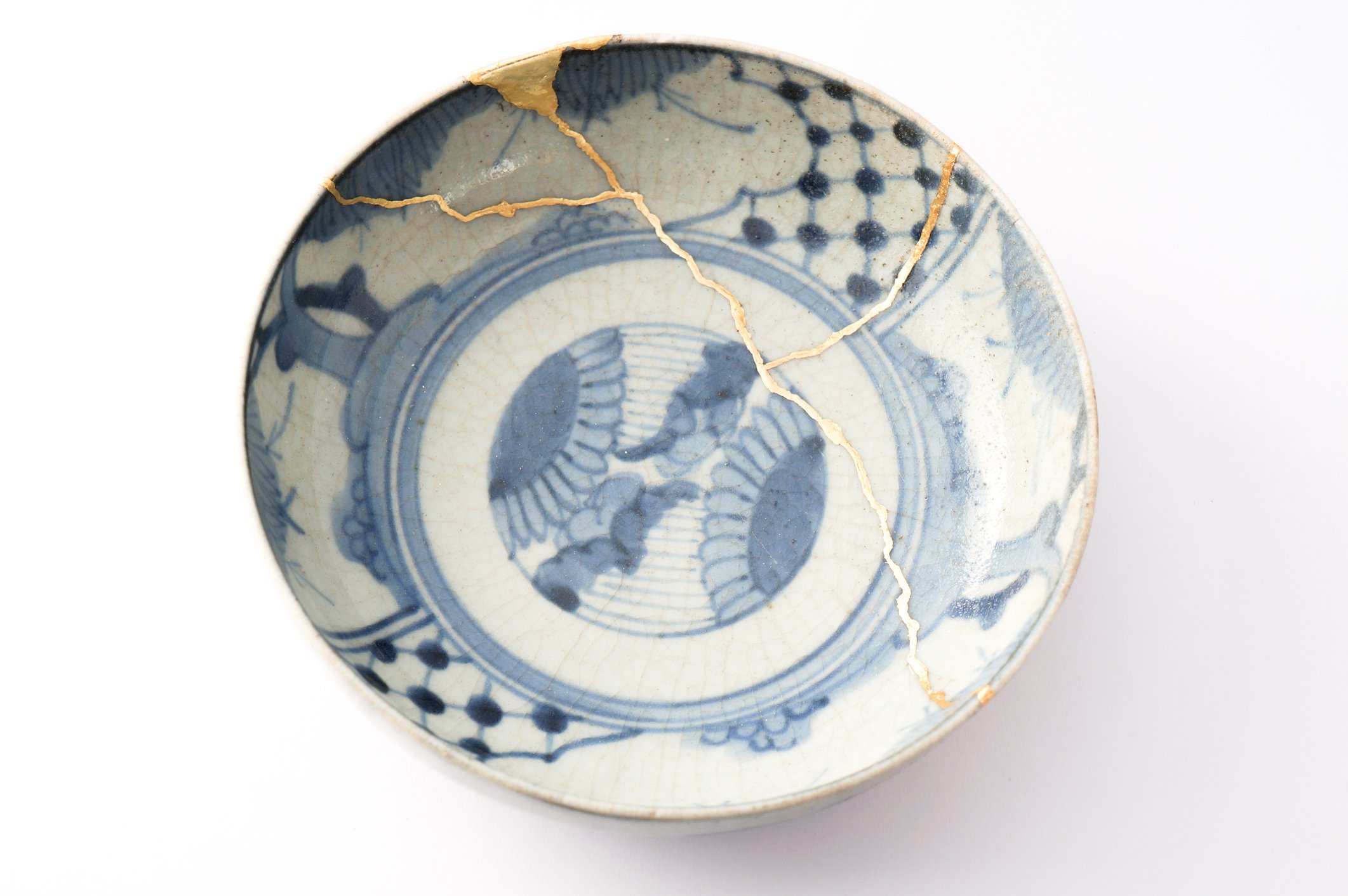
In Kintsugi, broken pottery is not repaired in a way that conceals its history. The fragments are carefully reassembled, and the lines where they meet are highlighted with gold.
In this article, I would like to explore what the break, the fragments, and the gold can represent, and how bringing the pieces together may gradually allow you to recognise who you are beyond your wounds and protective strategies.
What Is Complex Trauma?
Trauma is not defined by an external event alone. What also matters is how overwhelming the experience was, whether escape or protection was possible, what inner and outer resources were available, and whether anyone helped you regain a sense of safety afterwards.
Complex trauma describes the effects of repeated or prolonged experiences of helplessness, insecurity, humiliation, emotional neglect, or violence. These experiences can be especially formative when they occur within close relationships - particularly when the person you depend upon is also a source of fear or pain, and no reliable source of protection is available.
Under such conditions, the mind and body find ways to survive. You may learn to adapt closely to others, withdraw, disconnect from your emotions, remain constantly alert, take on too much responsibility, or lose contact with your own needs.
These responses are not conscious choices. They are adaptations to circumstances that could not be managed in another way at the time.
What once helped you endure may later become a source of distress, particularly when the response continues automatically even though the original danger has passed.
The effects of complex trauma often become more visible years later. They may appear as chronic tension, inner emptiness, harsh self-criticism, difficulties with trust and intimacy, physical symptoms, or a sense of disconnection from your body and your life.
Because these adaptations developed in response to different situations and needs, they may later seem contradictory or difficult to understand. Yet they are not evidence that something is fundamentally wrong with you. They show how your psychological and physiological systems adapted to experiences that were once overwhelming.
Trauma healing therefore does not begin by fighting these responses. It begins by understanding their protective function and gradually developing a greater capacity for safety, connection, and choice.
In my article on somatic therapy, I explain how the body and nervous system can be included in the processing of traumatic experiences.
What the Kintsugi Metaphor Means to Me
Kintsugi is a Japanese art of repair in which broken pottery is reassembled with lacquer. The repaired seams are often highlighted with powdered gold. The break is neither denied nor hidden; it remains visible as part of the object’s history.
For me, Kintsugi is more than a general symbol of healing. It reflects something essential about the therapeutic process: we turn towards what has been broken, separated, or concealed - not to reverse what happened, but to understand it and give it a place within a larger whole.
Like every metaphor, Kintsugi has its limits. Trauma does not mean that you, as a person, are broken. Rather, the image can help us understand how experiences, emotions, and protective responses that have become disconnected from one another may gradually be brought into relationship.
1. The Break: What Happened to You
The break represents experiences that were too painful, threatening, or overwhelming to process at the time.
Perhaps no one was there to protect you, take your feelings seriously, or help you understand what was happening. Perhaps you depended on the very people who also caused fear, insecurity, or pain. Or perhaps you had to adapt to circumstances over which you had little or no control.
When an experience is overwhelming, it may not be integrated into a coherent story. Sensations, emotions, memories, and beliefs can remain disconnected from one another. You may remember what happened without feeling it, feel something intensely without understanding why, or react in the present to a danger that belongs to the past.
The break does not mean that you were destroyed or permanently damaged. It represents a rupture in your sense of safety, trust, connection, and continuity.
2. The Fragments: How You Learned to Protect Yourself
After traumatic experiences, different protective responses may develop. In therapy, it can be helpful to speak of these responses as inner parts. Within the Kintsugi metaphor, I imagine them as individual fragments.
Perhaps there is a part of you that always keeps functioning, however exhausted you feel. A part that adapts to others in order to avoid rejection or abandonment. An angry part that defends your boundaries. A vulnerable part that withdraws before anyone can come too close. Or a controlling, high-achieving part that tries never to reveal uncertainty or need.
Each fragment carries part of your story.
These inner parts are not mistakes, and they are not signs of weakness. They are understandable responses to experiences that could not be managed differently at the time. Each tried, in its own way, to reduce danger, preserve connection, or prevent further pain.
Because they developed to meet different threats and needs, these protective responses may later pull you in opposing directions. The resulting conflict can be exhausting - especially when you do not yet understand what each part is trying to accomplish.
3. The Pile of Fragments: When You Cannot See a Coherent Self
When all you can see are separate fragments, it can be difficult to experience yourself as a coherent person.
You may recognise individual emotions, behaviours, and reactions without understanding how they belong together. Instead of seeing their context, you may interpret them as evidence that you are contradictory, unstable, or fundamentally flawed:
“I am too sensitive.”
“I am difficult.”
“I do not know who I really am.”
“Why do I react this way when I know I am not in danger?”
“There is something wrong with me.”
Perhaps you wonder why you long for closeness while simultaneously pushing people away. Why you remain composed during stressful situations, only to fall apart later. Or why you adapt so completely to others that you can barely recognise what you feel or need.
Behind these questions often lies a profound need for coherence: the wish to understand your emotions, reactions, and experiences as parts of one connected story.
When the fragments appear unrelated, the form of the whole remains difficult to see. What looks like inconsistency may, however, begin to make sense once each response is understood in relation to the circumstances in which it developed.
4. Looking at and Sorting the Pieces Together
In therapy, we can spread the fragments out before us together.
We do not have to reassemble them immediately. First, we look at them - gently, carefully, and with as little judgement as possible.
What experience does this fragment carry?
When did this protective response develop?
What was it trying to prevent?
What emotion did it have to contain or keep at a distance?
What need could not be met at the time?
What does this part need now?
How is it connected to the other parts of your story?
This process requires acknowledgement and acceptance. It asks for openness towards what emerges and, at times, the courage to approach something that had to remain hidden for a long time.
Not every experience can be understood through thought alone. Therapy may therefore also involve learning to recognise and safely experience suppressed emotions, noticing how they are expressed in the body without allowing them to become overwhelming.
Acceptance does not mean approving of what happened, excusing those who caused harm, or resigning yourself to its consequences. It means acknowledging the reality of your experience and no longer turning the responses that arose from it against yourself.
Not every fragment needs to be picked up immediately. Not everything needs to be examined, remembered, or spoken about at once. Trauma therapy needs to proceed at a pace your nervous system can tolerate. Sometimes the most important work is not approaching a painful memory, but strengthening your capacity to remain present, notice your limits, and choose when to pause.
You decide which fragment we approach and how closely we look at it. My role is not to tell you what form you should take. It is to accompany you as we explore how your different parts belong together and what they reveal about your history, your needs, and your ways of protecting yourself.
5. The Gold: What Can Emerge Between You and Me
In Kintsugi, the fragments are not simply placed beside one another. They are joined with care.
For me, the gold does not represent the trauma itself. Nor does it suggest that painful experiences automatically make someone stronger, wiser, or more valuable. No one needs to be grateful for what happened, and suffering does not become beautiful simply because healing is possible.
The gold represents the quality of attention with which we turn towards what has been experienced.
It is made of patience, care, honesty, openness, and genuine interest. It is the willingness to understand parts of yourself that you may previously have rejected, feared, or fought against. It is also the experience of a relationship in which you can gradually show more of yourself without having to justify your feelings, minimise your history, or perform a particular version of who you are.
This gold can emerge between you and me - or within another trusting therapeutic relationship. It appears in moments when you no longer have to carry an experience alone; when an emotion is given space without taking over; when a boundary is noticed and respected; and when an inner part is approached not as a problem to eliminate, but as a response with a protective purpose.
It can also appear when something difficult happens within therapy itself—when there is uncertainty, misunderstanding, distance, or hesitation—and we are able to notice it, speak about it, and find our way back into contact. Such moments of relational repair can offer an experience that may have been missing in earlier relationships: connection does not always have to be perfect in order to endure.
Within this shared process, connections gradually begin to form:
between the past and the present,
between bodily sensations and emotions,
between protective strategies and underlying needs,
between what you experienced and the beliefs you developed about yourself,
between the different parts of your personality.
Over time, the compassionate attention first experienced within the therapeutic relationship may also become a way of relating to yourself. You may begin to meet your own reactions with greater curiosity and less shame.
The fragments are not removed, and your protective parts do not simply disappear. Instead, they are given an understandable place within the whole. As they become more connected, they no longer need to govern your life in isolation from one another.
6. Your Own Shape Becomes Visible
At the beginning, we may not yet know what kind of vessel the fragments belong to. Is it a cup, a bowl, a plate, or a vase?
Many people affected by complex trauma know more clearly who they are expected to be than who they experience themselves to be.
Perhaps you spent years trying to become the person others wanted or needed. You may have learnt to be agreeable, high-achieving, unobtrusive, undemanding, helpful, or strong. Perhaps you developed a precise idea of who you had to be in order to remain loved, safe, or accepted.
Beneath these expectations and adaptations, it can become difficult to recognise your own preferences, boundaries, desires, and values.
Bringing the pieces together is therefore not about turning you into a new or better person. Nor is it about forcing the fragments into a predetermined form - whether mine, yours, or anyone else’s.
As we explore what belongs together, your own shape can gradually emerge. You may begin to see yourself not as a collection of flaws, symptoms, or incompatible parts, but as a person whose reactions are understandable in the context of what they have lived through.
The question begins to change from:
“What is wrong with me?”
to:
“How do my feelings and actions make sense in the context of what I have experienced?”
Qualities that were once closely tied to survival may also become visible in a new way.
Someone who learnt to monitor other people’s moods as a child may, for example, develop considerable sensitivity to subtle emotional changes. This capacity can be valuable. But it becomes a freely available resource only when it is no longer driven automatically by fear or by a sense of responsibility for everyone else’s emotional state.
Integration does not mean relabelling every survival strategy as a strength. It means gaining more freedom in how you relate to it. When is this ability useful? When does it lead you to disregard your own boundaries? When are you choosing it, and when does it still feel as though you have no choice?
Healing expands the space in which such choices become possible.
7. A More Coherent Sense of Self Emerges
Over time, a fuller picture of who you are may begin to emerge - not only what happened to you, what others believed about you, or who you once needed to become.
Psychologically, a more coherent sense of self begins to develop.
Your different inner states are no longer experienced solely as evidence that you are wrong, unstable, or damaged. Instead, they can be understood as connected aspects of your personality and history.
Coherence does not mean being consistent at all times, free from inner conflict, or perfectly regulated. It means being able to recognise your different responses, understand how they relate to one another, and hold them within a broader sense of who you are.
You can long for closeness and also be afraid of it. You can be vulnerable and strong. You can care deeply for others while setting firm boundaries. You can understand why a protective part developed without continuing to let it make every decision for you.
As your understanding of yourself grows, so does your freedom to choose. Emotions may feel less threatening. Boundaries may become clearer. Relationships may become more reciprocal and intentional. And your past, while still part of you, may have less power to organise your present.
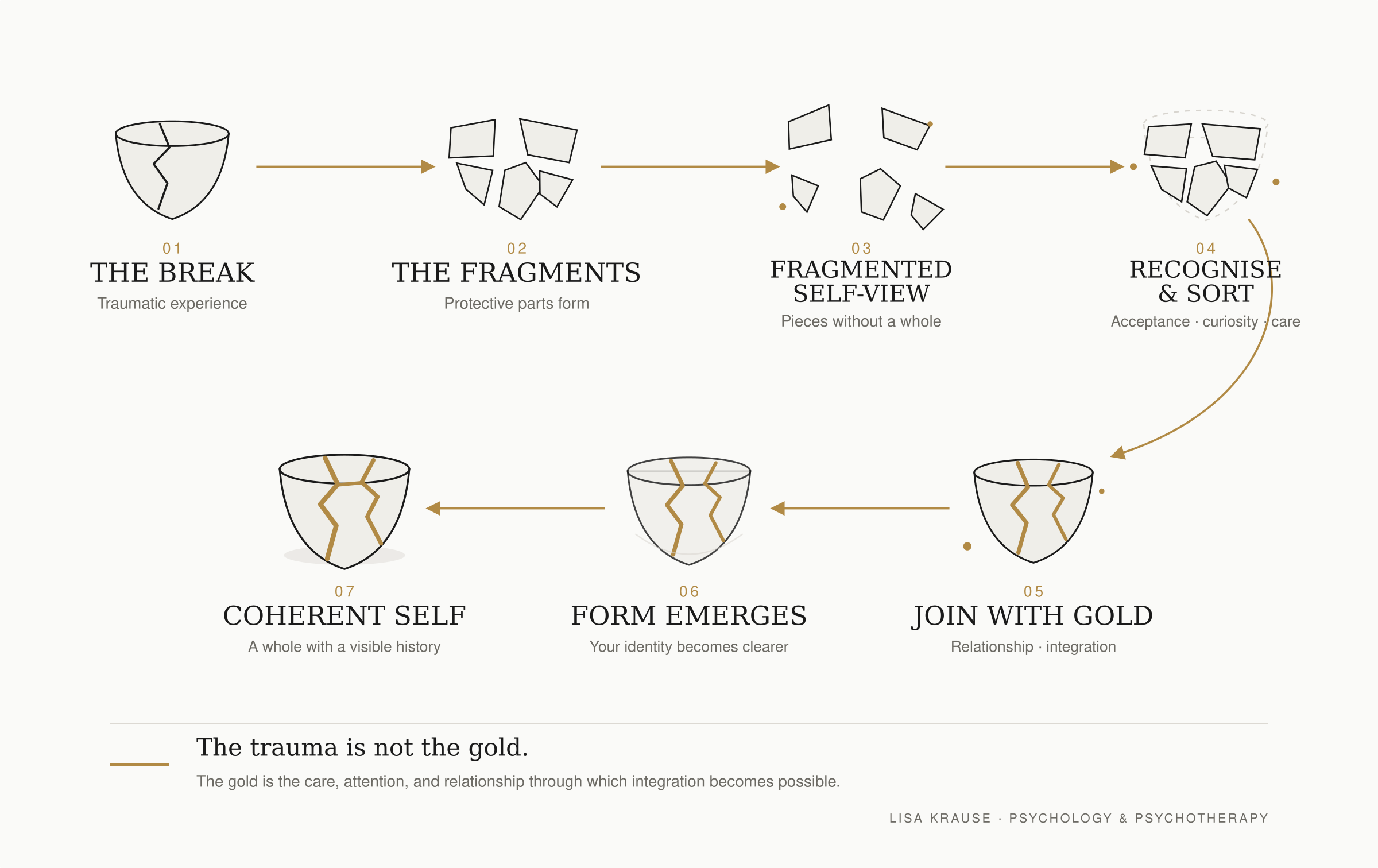
Minimalist infographic illustrating Kintsugi as a metaphor for the therapeutic process. Across seven stages, it shows how a traumatic experience can lead to fragmentation and the development of different protective parts. Through acknowledgement, curious exploration, and therapeutic integration, the fragments are joined with golden seams until a more coherent sense of self becomes visible. The gold does not represent the trauma itself, but the care, attention, and relationship through which integration becomes possible.
The Beauty Is Not in the Breaking
What emerges is not a flawless vessel with no sign of where it once broke. It is a more integrated whole whose history is allowed to remain visible.
The golden lines do not mean that the trauma was beautiful, meaningful, or necessary. They represent the care, compassion, and therapeutic work through which experiences that were once separated could gradually be brought into connection.
You are more than the fragments you notice within yourself. And you do not need to become an idealised version of who you think you should be.
As the pieces come together, who you already are can become more visible - with your needs and boundaries, your vulnerability and strength, your anger, longing, tenderness, and aliveness.
The traces do not have to disappear. They can remain part of your story without defining your entire sense of self or determining the direction of your life.
For me, the beauty is not in the breaking.
It lies in the care with which you learn to recognise your different parts as belonging to you - and in the gradual emergence of your own shape.

What if your cracks aren’t flaws to hide, but parts of your story waiting to be understood?
If you’re ready to begin this inner work, to listen, feel, and reconnect with yourself, you’re warmly invited to start here: